Built together.
Designed to perform.
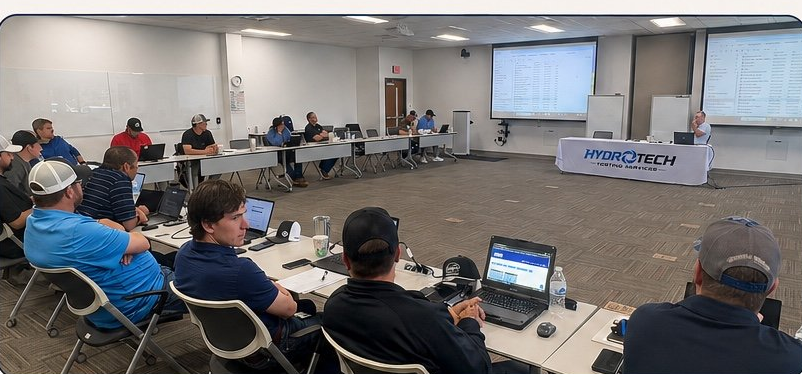
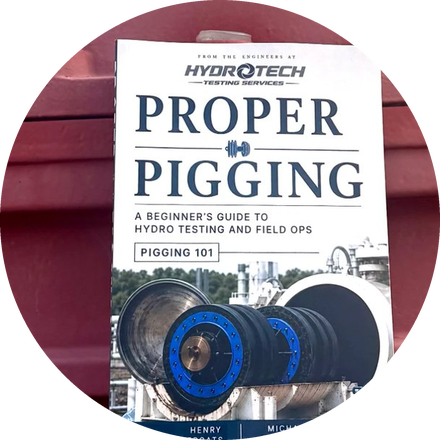
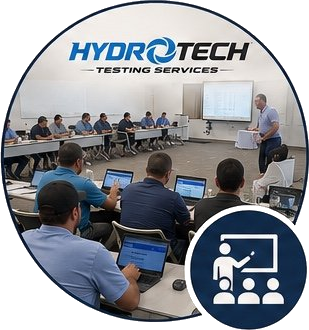
The Proper Pigging book and the HydroTech Testing in-person class work hand in hand to give engineers the knowledge, skills and confidence to excel in the field.

Real confidence. Continuing education credits · Professional development · Career advancement
 In-person trainingLearn from experienced instructors and industry professionals.
 Continuing educationEarn contact hours toward CEU and PDH to maintain your licence and meet professional development goals.
 Practical applicationApply what you learn in class with the proven reference in the Proper Pigging book.
 Career growthBuild the skills and confidence to take on bigger challenges and advance your career.
One book · One class · Taught by the crews who run the work In-person instruction at our facility or yours
Continuing EducationAppendix F
Continuing education for gas and oil
Three courses on hydrostatic and nitrogen pressure testing for pipeline engineers, inspectors, and operations personnel, taught by the field crews who plan and execute the work, with this book as the text.
Operator qualification demonstrates that a person is qualified to perform a covered task. It does not demonstrate that the person understands why the pressure moved six psi at two in the morning. Qualification and competence are different things, and the distance between them is where tests get argued about instead of accepted. These courses exist to close that distance.
Plate IIIChapter 4.3
Courses
Executive and Project Briefing
4 contact hoursFor managers, project engineers, and owner’s representatives who buy, schedule, and accept pressure tests. No calculation is required of participants. The objective is fluency: to read a pressure ladder, interpret a test window, recognise a defensible acceptance argument, and scope a contract that will not produce surprises.
- Why tests succeed and fail. The regulatory framework, the two distinct jobs of a test, and the planning decisions that must close at six months, one month, and one week. Ch. 1, 5
- Reading the numbers. Pressure ladders, test windows, and the pressure-temperature justification. Ch. 2, 6, 12
- Where the schedule really goes. Water, stabilisation, and drying as the true schedule drivers. Ch. 7, 8, 15
- The record that survives. Life-of-line record requirements and the documentation an operator should demand from any contractor. Ch. 14
Engineering Workshop
8 contact hoursFor pipeline engineers and inspectors. Adds calculation practice to the briefing track. The asterisked problems of Appendix E are worked through in full, and a 16-inch crude oil pipeline is engineered end to end over the course of the day.
- Mechanics and media, with worked problems: Barlow’s formula, allowable elevation windows, system compliance, pressure-temperature response, and gas-law nitrogen inventory. Ch. 2, 3
- Engineering the test end to end: spike, strength, and leak pressures; segment breaks; fill and pressurisation volumes; site layout. Ch. 6
- Execution and analysis: instrumentation placement, the pressure-volume plot, the weighted-temperature worksheet, and the balance statement. Ch. 10–12
- Acceptance case study, worked as a group exercise from real field data. App. C
Field Certification
Two days · 10 contact hoursThe complete programme, and the standard HydroTech’s own crews are trained against. The whole book, taught with equipment displays and field-reality sessions, with the checklists of Appendix A run as live exercises.
- Day one, morning. Foundations: why we test and what a test cannot do; the mechanics of pipe under pressure; how water, nitrogen, and product behave.
- Day one, afternoon. Pigging with hardware in the room; launchers, receivers, and temporary headers; trains, tracking, and valve coordination; the planning framework and the countdown timeline.
- Day two, morning. Developing the pressure ladder; segment-break screening on a real profile; volumes and stroke budgets; water sourcing and permitting; isolation, purge, and line fill; conducting the test and building the plot live.
- Day two, afternoon. The weighted-temperature worksheet; the acceptance case study; documentation and the life-of-line record; dewatering, drying, and discharge; when the test fails.
Private instruction
Courses are arranged privately
We do not run open-enrolment sessions and we do not publish a public calendar. Every course is arranged privately for a single operator, engineering firm or contractor, and scheduled around your work rather than ours — at the HydroTech facility or at yours.
That is deliberate. A private course is taught against your own procedures, specifications and acceptance criteria, using your line profiles rather than a generic example, and the conversation stays inside your organisation. Tell us the headcount and the rough timeframe and we will scope it.
Certification of attendance
Each participant receives a certificate of completion recording the course title, contact hours, date, course objectives, and instructor, which is the form most state boards require when an engineer submits professional development hours.
Continuing-education acceptance is determined by the participant’s individual licensing board and not by HydroTech Testing Services. Those attending for credit should confirm acceptance with their board beforehand.
How private courses work Instruction at your facility For training managers
Instructors
Henry Froats Jr. — instruction and field examples
Owner and Director of HydroTech Testing Services, where he leads pipeline commissioning and testing operations across the Appalachian gas fields and the tristate region. Henry and the HydroTech crews teach from the work itself: hydrostatic test planning and execution, nitrogen purging, drying and packing, pigging operations, and the client-facing engineering that turns a test plan into an accepted record. The jobs discussed in the room are jobs they ran.
Hands-on demonstration
Classes are taught with hardware in the room rather than photographs of it. Where the site allows, we can bring a NitroTech N2 nitrogen trailer to the training so the group can see how bulk nitrogen is actually rigged, metered and worked on a jobsite — the same purpose-built equipment that runs the purging, drying and packing described in the book.
Michael Schricker
Director of AI and Marketing Technology for HydroTech Testing Services, where he builds the digital side of the company’s field practice: developer of the free HydroTech Pocket Engineer application that companions Appendix B, and architect of HydroTech’s AI-assisted field tools, client portal, and technical publishing programme. He brings an eighteen-year executive career in marketing and technology, and holds graduate credentials in analytics and corporate communications.